
.svg)

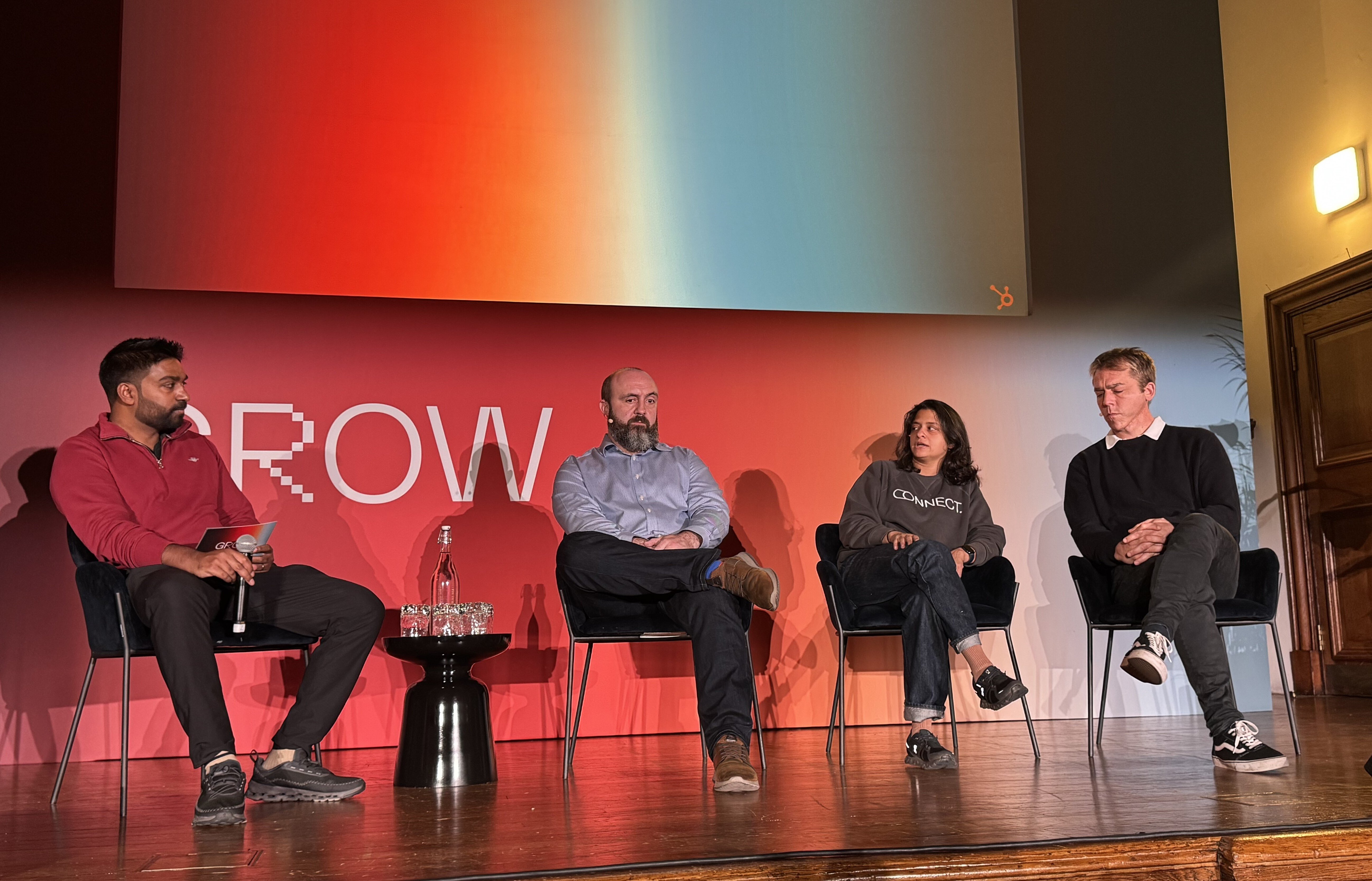
At the GROW Europe 2025 conference, a panel of leading investors: Uthish Ranjan (Octopus Ventures), Will Wells (Speedinvest), Sitar Teli (Connect Ventures), and Luke Smith (Molten Ventures), tackled one of the most contentious issues in venture capital today: valuations.
The discussion, moderated by Ranjan, cut through the noise surrounding billion-dollar rounds, inflated pre-seed deals, and the perception that the market has lost touch with fundamentals. What emerged was a grounded, data-backed assessment of where valuations truly stand in 2025, how venture funds are responding, and what founders must do to raise capital responsibly in this new cycle.
The Great Valuation Divide
The panel agreed that the market has become sharply bifurcated. As Luke Smith of Molten Ventures described it, there are “a small subset of very hot companies” commanding outsized valuations, while the rest of the market faces longer fundraising timelines, smaller rounds, and tougher diligence.
“The bar for what counts as really good has risen,” Smith said. “You see a small subset of companies growing extremely fast, attracting huge attention, and getting the rounds they want. But that’s a tiny fraction of the overall deal market.”
 These companies, often AI-native, highly visible and sometimes founder-led by repeat entrepreneurs, create the illusion of a buoyant market. In reality, most founders face a far more cautious environment. Fundraising now demands more substantial revenue traction, evidence of product-market fit, and a clear path to sustainable margins.
Will Wells: “We’re Past the $40 Million Pre-Seed Round”
Will Wells, Partner at Speedinvest, offered perhaps the most blunt assessment of current valuations:
“I’m now not doing calls with another $40 million pre-seed robotics or AI foundational company. We’re past that now.”
Wells explained that in late 2023 and early 2024, a wave of early-stage founders, particularly in AI and deep tech, raised enormous rounds at eye-watering valuations, often on the basis of a compelling demo or well-known backers. But that phase, he argued, was fuelled by momentum and short-term exuberance.
“We’ve told our team to stop focusing on the noise,” he said. “Instead, spend all your energy finding exceptional founders coming out of places like Palantir or DeepMind, people with genuine technical depth and a reason to build, not just a pitch deck and hype.”
For Wells, the key distinction is between capitalised ambition and capital inefficiency. He noted that while deep tech companies often need more upfront investment, there’s a difference between legitimate capital intensity (e.g., chip design, fusion, compute infrastructure) and simply over-raising in a race to appear competitive.
“The very best founders will always raise rounds that give you heartburn,” he admitted. “But those should be the exceptions, not the norm.”
Sitar Teli: “Ignore the Noise, and the Journalists”
Sitar Teli, Managing Partner at Connect Ventures, shared a similar sentiment but from the seed-stage perspective. She pointed out that inflated valuations at the earliest stages create distorted expectations and can compromise long-term capital efficiency.
“We have a fund size and portfolio construction strategy that dictates what kind of rounds we can and should do,” Teli explained. “We play the game that leads to winning, and that’s not doing $40 million seeds.”
Teli also criticised the way tech journalism amplifies the extremes of the market.
“Journalists like to talk about things that make readers emotional, the outrageous rounds, the nine-figure valuations. But no one writes about the £2–3 million seeds, even though that’s where most of the market is operating,” she said.
Her point underscores a broader issue: the perception gap between media narratives and actual venture activity. While headlines focus on record-breaking deals, the real venture economy remains anchored in smaller, disciplined rounds.
Teli’s approach remains consistent: she seeks capital-efficient businesses that don’t rely on raising multiple large rounds just to survive. “It’s fine to be ambitious,” she said, “but the path should show a credible route to product-market fit without needing to go back to market every 12 months.”
Luke Smith: “Valuation Must Leave Room for Imperfection”
At the Series A stage, Luke Smith offered a pragmatic framework for assessing valuation discipline. He said the key questions his team asks before committing to a deal are:
-
Can the company exit at a valuation that delivers the required fund-level returns?
-
Does the post-money valuation set the company up for success in its next round?
“If you’re raising at a price that assumes perfect execution, you’re setting yourself up for a painful future,” Smith said. “We don’t want founders who need to execute flawlessly just to avoid a down round.”
Smith added that many promising companies are tripped up not by poor products but by valuations that are misaligned with their next milestone. The result is a cycle of internal bridge rounds or down rounds that erode founder equity and investor confidence.
His advice to founders: focus on valuation fit, ensuring that the price you raise today reflects where your metrics, team, and market position will be in 12 to 18 months.
Capital Discipline as a Competitive Advantage
While the 2022–2023 market correction initially felt painful, all panellists agreed it has ultimately reintroduced discipline and clarity into venture investing. Funds are once again focused on fundamentals: margins, retention, customer concentration, and efficiency of spend.
Teli observed that many AI application-layer startups still suffer from weak gross margins, largely due to dependency on third-party models and APIs. In that context, raising too much too soon can be a liability. “If your cost structure doesn’t improve, over-raising only magnifies your problems,” she warned.
Wells echoed that the strongest founders are those who raise responsibly and deploy capital with precision. “We’re backing founders who think about cash like engineers, measurable, optimised, and efficient,” he said.
A Market Returning to Rationality
Despite the ongoing hype around generative AI and infrastructure investing, the message from the GROW Europe panel was clear: the market is recalibrating. The days of $50 million pre-seed rounds and growth-at-all-costs strategies are fading.
In their place, a more mature ecosystem is taking shape — one where valuation reflects substance rather than speculation.
Uthish Ranjan, who moderated the discussion, closed by summarising the consensus:
“Great founders will always raise capital, but today the best investors are distinguishing between funding ambition and funding hype. The firms that keep that distinction clear will define the next decade of European venture.”
In Summary
Valuations in 2025 are no longer a one-size-fits-all phenomenon. There’s still exuberance at the top end of the market, but experienced investors like Wells, Teli and Smith are reinforcing a new discipline:
-
Valuation must reflect real progress, not potential alone.
-
Over-raising early is often a trap, not a trophy.
-
And above all, capital efficiency is once again the mark of a world-class founder.
At Sapphire, we believe that the next generation of European venture success stories won’t be the ones that raised the biggest early rounds, but the ones that raised the right ones. Hopefully, the panel would agree with this assessment.
.png?width=2752&height=1536&name=unnamed%20(3).png)
Next Steps:
If you would like advice on how to perform a valuation, or how to set up an investment fund, such as a GP/LP fund or an EIS fund, or if you need an FCA authorised operator and manager to manage the fund, or need pricing and options, fill out this form, and we will be in touch right away.
Disclaimer:
This content is provided for information purposes only and does not constitute investment advice or any form of recommendation.
.png)