




Today’s HM Treasury Women in Finance town hall indicated to me just how important the next decade will be for gender balance in UK financial services.
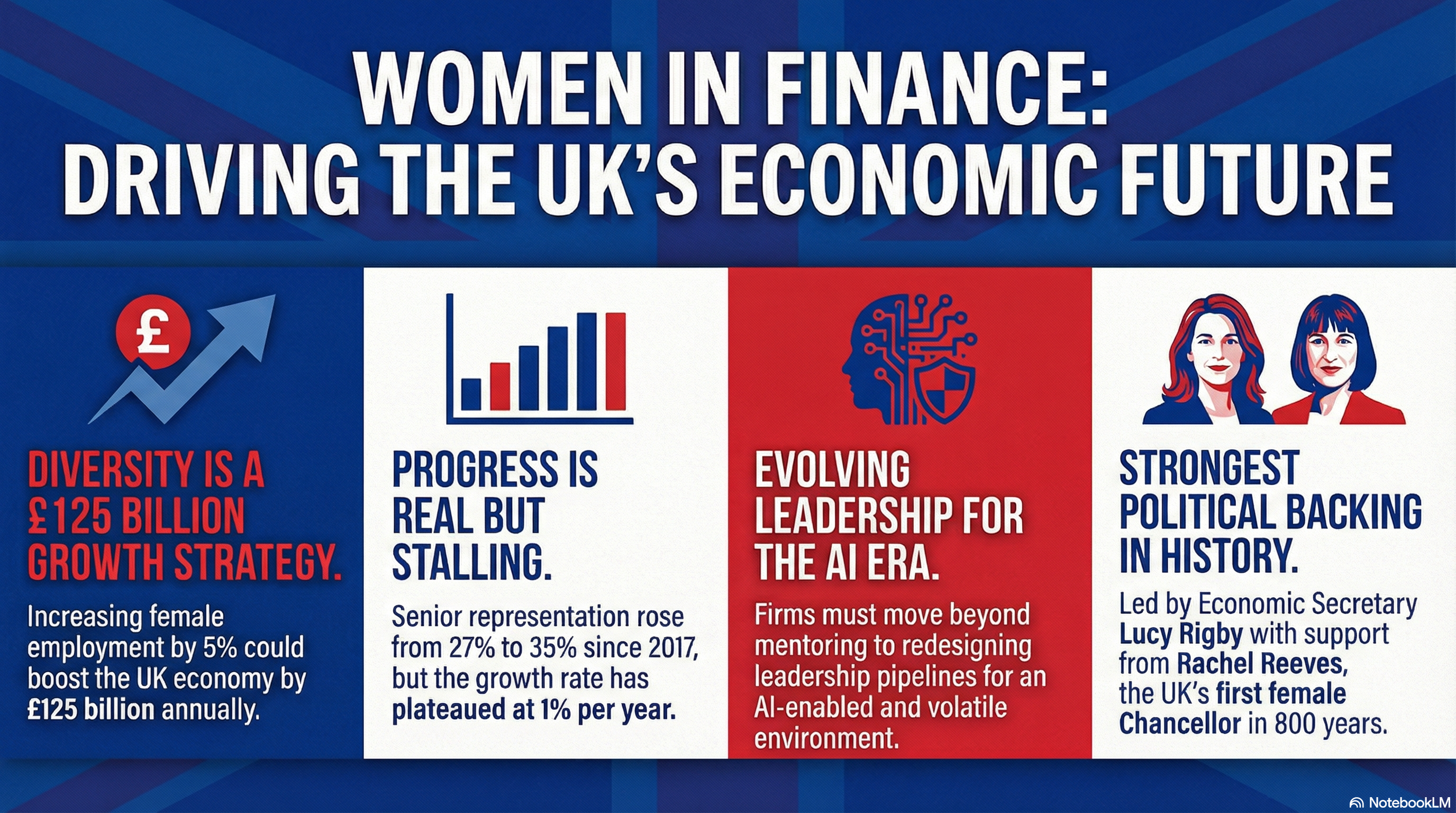
Launched in 2016 to drive senior female representation across the sector, HM Treasury's Women in Finance Charter has grown from 68 signatories in 2017 to more than 400 today, spanning banks, insurers, asset managers, advisers and infrastructure providers. Women now hold around 35% of senior roles among signatories, up from 27% in 2017. This signifies meaningful progress in under a decade.
But the mood in the room was far from complacent. The current rate of improvement is only about one percentage point a year, with some firms moving backwards and a visible plateau as organisations approach their self‑set targets. The message from the Treasury was blunt: "business as usual" such as mentoring schemes, networks, flexible working policies will not get the sector where it needs to be. Boards are expected to interrogate why momentum has slowed and what structural shifts are required.
Politically, the Charter is moving up the agenda rather than fading into the background. Economic Secretary Lucy Rigby is now leading the efforts, backed by Chancellor Rachel Reeves. This signals the importance of the Charter's work as well as increasing expectations on transparency, targets and delivery.
The economic argument is becoming harder to ignore. According to HMT statistics:
-
Women’s economic inclusion has accounted for roughly 40% of UK growth since 2000.
-
A further 5% increase in female employment could boost the economy by an estimated £125 billion a year.
For a sector that prices risk and allocates capital, under‑utilising female talent is being reframed as an mis-pricing problem; one that directly affects productivity, innovation and long‑term returns. Internationally, the UK’s approach is being watched and copied: the Charter has already inspired similar initiatives in Ireland, Luxembourg and Norway.
A key theme of the town hall was delivery. Dame Debbie Crosby, CEO of Nationwide, has been appointed as the new Women in Finance Champion, succeeding Dame Amanda Blanc. Her focus is on how firms actually run. That means:
-
rethinking leadership models for an AI‑enabled, volatile environment;
-
designing career paths that keep women in the workforce during peak caring years; and
-
making the link between diverse senior teams, better decision‑making and growth.
It also means addressing the external pushback on diversity initiatives, keeping the conversation grounded in evidence rather than rhetoric, and bringing men in as active sponsors rather than bystanders. Regional hubs such as Leeds, Manchester, Cardiff and Glasgow are firmly in scope too, with a push to ensure progress is not confined to London headquarters.
Crucially, the Charter is widening its lens. Future work will look at how AI could reshape roles and opportunity pathways, with a deliberate focus on avoiding the replication of old biases in new systems. There is also growing recognition that gender outcomes are intertwined with class and socioeconomic background. This raises deeper questions about who gets to enter, stay and lead in financial services.
For Sapphire Capital Partners, the learning is clear in that the conversation has moved on from “why diversity?” to “what structures and incentives are you putting in place to deliver it?”. Those that respond early and thoughtfully have the opportunity not just to contribute to a more inclusive sector, but to build stronger governance, sharper decision‑making and more resilient performance for the decade ahead.
This article is for general information purposes only and does not constitute investment advice or an offer to invest.
Below is a video summary of this article.
Next Steps:
If you would like advice on how to perform a valuation, or how to set up an investment fund, such as a GP/LP fund or an EIS fund, or if you need an FCA authorised operator and manager to manage the fund, or need pricing and options, fill out this form, and we will be in touch right away.
Disclaimer:
This content is provided for information purposes only and does not constitute investment advice or any form of recommendation.