
.svg)

At Sapphire , we operate at what might feel like a considerable distance from the boardrooms of London's financial district. As a small-scope Alternative Investment Fund Manager based in Belfast, Northern Ireland, we might be forgiven for thinking that the big conversations happening at HM Treasury level don't quite apply to us. But they do, perhaps more acutely than many realise.
The 2025 HM Treasury Women in Finance Charter Annual Review and the accompanying webinars hosted to discuss its findings reminded me why every firm has a stake in this agenda. When we layer in the academic research on board diversity and corporate innovativeness, the picture becomes both more compelling and more urgent.
The Numbers Tell a Complicated Story
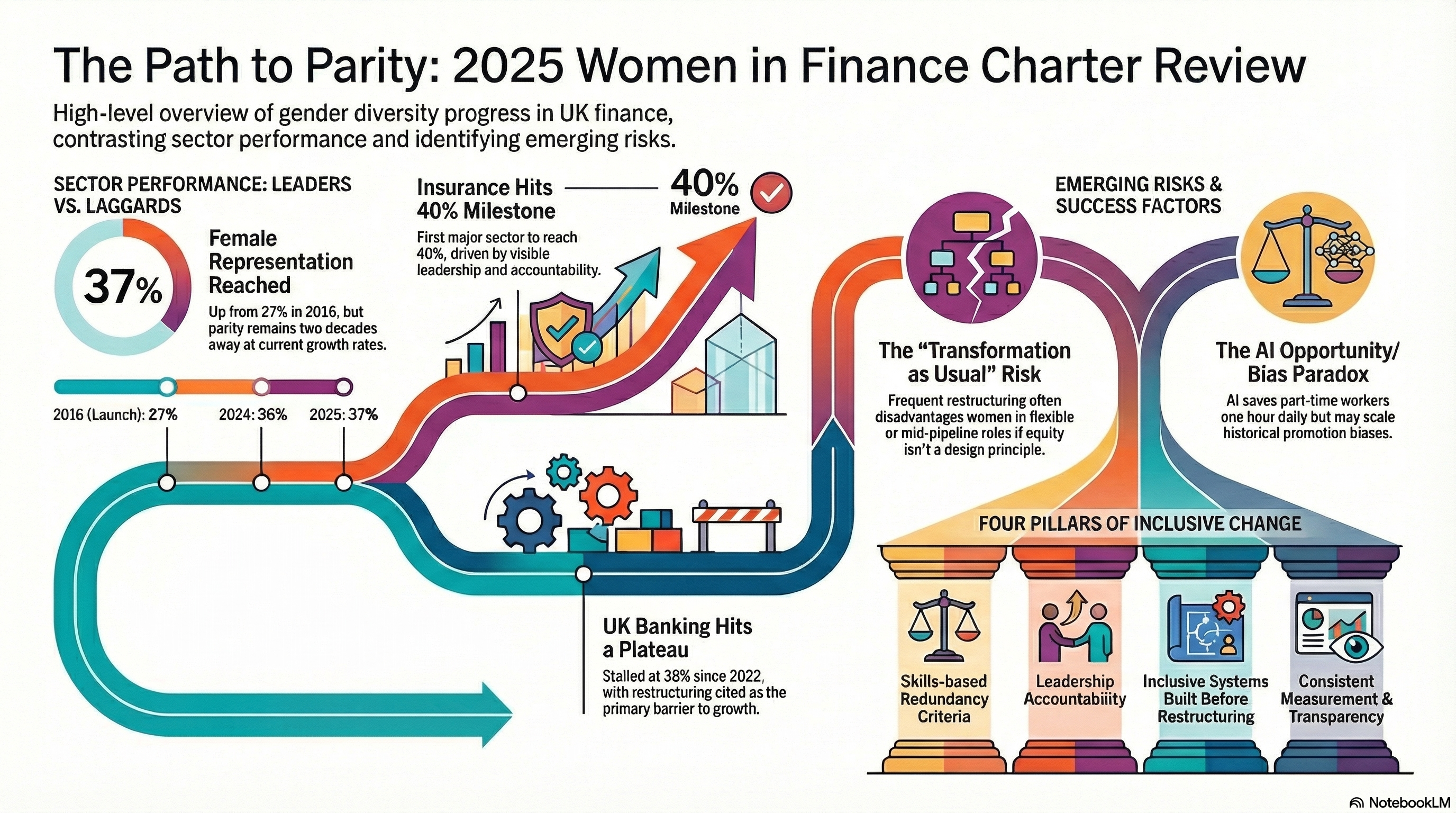
The headline figure is encouraging: average female representation in senior management across the 210 Charter signatories analysed has reached 37%, up from 36% in 2024. This is genuine, documented progress from the 27% recorded when the Charter launched in 2016.
But as Chancellor Rachel Reeves noted plainly in her foreword to the review, a steady one percentage point per year is not enough. At this rate, parity remains two decades away.
For smaller firms like ours, the challenge is different in character but no less real. We don't have the resources of a global investment bank, nor the HR infrastructure of a major insurer. In a small team, one departure or one poor hiring decision can move the dial dramatically. That makes intentionality not just admirable, it makes it essential.
The Insurance Sector's 40% Milestone: What They Did Right
One of the most genuinely exciting findings from the 2025 review is that the insurance sector has become the first of the four largest Charter sectors to reach an average of 40% female representation in senior management. This didn't happen by accident.
During the webinar, panellists Karen Blake MBE, Rachel Osikoya, and Cheryl Toner pointed to several interwoven factors: strong visible leadership from figures such as Dame Amanda Blanc at Aviva and Tara Foley, a collective industry commitment through initiatives and a cultural shift that made diversity a genuine business priority. Notably, 47% of accountable executives in the insurance sector are now female, up from 40% in 2024.
The academic literature backs this up. Research published in Humanities and Social Sciences Communications (Hakovirta et al, 2020) found that boards with higher female representation demonstrate better share liquidity, stronger oversight, and greater price informativeness. The insurance sector's success story suggests that when firms treat gender diversity as a genuine strategic lever rather than a compliance exercise, meaningful results follow.
For us in Belfast, the lesson scales: culture, leadership visibility, and consistent accountability mechanisms are the drivers of change, not organisational size.
UK Banking's Plateau and the Transformation Challenge
In sharp contrast, the UK banking sector has been stuck at 38% since 2022, making it the only sector to remain entirely flat year-on-year, with nearly half of UK bank signatories actually decreasing female representation during the reporting period.
The primary culprit is organisational restructuring, cited as the most common reason signatories missed their 2025 targets. The webinar introduced a concept that resonated strongly: the shift from "business as usual" to "transformation as usual." Change is no longer an episodic event; it is the permanent condition of operating in financial services.
This creates a particular risk for gender equity. When organisations restructure, women who are more likely to be working flexibly, in mid-pipeline roles, or in support functions can find themselves disproportionately disadvantaged through entirely gender-neutral-sounding processes.
Karen Blake MBE, Rachel Osikoya, and Cheryl Toner identified four key success factors for managing transformation without sacrificing diversity progress:
- Embed equity as a design principle in change processes from the outset.
- Use transparent, skills-based criteria for redundancy and redeployment decisions.
- Hold leaders accountable through governance structures that track demographic outcomes through restructures.
- Build inclusive transformation into systems before restructures occur, not during or after.
As a small firm navigating a changing regulatory landscape and evolving client expectations, the discipline of embedding equity into change (rather than hoping it survives change) is something we take seriously.
The AI Dimension: Opportunity or Amplified Risk?
Perhaps the most forward-looking discussion in the webinar centred on artificial intelligence. The sector remains in early-stage adoption, but the implications for gender equity are already visible, and not all of them are positive.
On the opportunity side, AI tools such as Microsoft Copilot are reportedly saving part-time workers approximately one hour per day. Given that women represent around 90% of the part-time workforce at some larger firms, this is a meaningful and perhaps underappreciated development.
The risk side demands equal attention. AI systems trained on historical data will, by definition, reflect historical biases. If past promotion decisions underweighted women, and the data across financial services suggests they did, then AI tools will perpetuate that underweighting at scale and at speed. The panel called for algorithmic accountability, rigorous auditing of AI tools for bias, transparent work allocation in technology projects, and governance structures that embed diversity considerations into AI stage-gate processes from the outset.
The academic research on board diversity reinforces this. The study comparing the boards of the world's most innovative companies with major bioeconomy firms found that more innovative companies demonstrated greater diversity of age, ethnicity, and educational background, not just gender. The argument is not simply moral but strategic: diverse perspectives produce better decisions. If AI systems are shaping decisions about talent and promotion, then diverse oversight of those systems is not optional; it is a precondition of good governance.
The Board Diversity Imperative: More Than a Numbers Game
The academic research offers a useful corrective to the tendency to reduce diversity to a single metric. Analysing the boards of the world's ten most innovative companies alongside the ten largest bioeconomy firms, researchers found that the most innovative companies had greater ethnic diversity, broader age distribution, higher average educational attainment, and more engineering graduates. Notably, gender diversity was identical between the two groups, (both at 25% female) suggesting that gender alone does not account for the innovation gap.
This is not an argument against gender diversity. The research is clear that boards with higher female representation perform better across multiple metrics, and that at least three female directors are needed for any meaningful positive influence. The point is that gender diversity is necessary but not sufficient. True board effectiveness requires diversity of thought, background, experience, discipline, and perspective.
For Sapphire, this resonates directly. Operating at the intersection of alternative investments, ESG considerations, and an evolving regulatory environment in post-Brexit Northern Ireland, we need the broadest possible range of perspectives informing our decisions. Northern Ireland's talent pool is genuinely diverse and genuinely underutilised by the financial services sector. One quiet advantage of being based here is that we are not fishing in the same exhausted pond as firms competing for the same narrow profiles in London. That is an advantage we intend to use.
Flexible Working: The Invisible Risk
One of the newer areas of focus in the 2025 review is flexible working data. Two thirds of signatories now capture data on flexible working arrangements in their senior management population, but only 10% provided detailed breakdowns, and the review notes a significant gap between formal and informal flexible arrangements.
This matters. If senior women are working flexibly but that flexibility is not captured in data, then promotion processes and succession planning may be operating on the assumption that they aren't. The invisible flexible worker is systematically undervalued.
As a small firm, flexibility is often a matter of conversation and trust rather than formal policy. That informality can be a strength but it requires conscious effort to ensure it isn't producing quiet disadvantages for women in our team and networks.
Our Commitment
The HMT Women in Finance Charter's principles of accountability, transparency, targets, and a genuine link between leadership behaviour and outcomes are not the exclusive province of large institutions. They are the building blocks of good governance at any scale.
As Sapphire, we are committed to being intentional about diversity in every hiring, promotion, and advisory decision; treating flexibility as the norm and ensuring it is valued rather than penalised; engaging critically with AI tools as we adopt them; and supporting an ecosystem that recognises the business case for diverse leadership as empirically grounded, not aspirational.
The 2025 Women in Finance Charter Annual Review is a record of genuine progress and, read honestly, of how much further there is to go. We read it not as a critique of others but as a prompt for our own reflection.
From Sapphire's perspective, we're watching, learning, and working to do our part.
Below is a video summary of this article.
Next Steps:
If you would like advice on how to set up an investment fund, such as a GP/LP fund or an EIS fund, or if you need an FCA authorised operator and manager to manage the fund, or need pricing and options, fill out this form, and we will be in touch right away.
Disclaimer:
This content is provided for information purposes only and does not constitute investment advice or any form of recommendation.